📘 Enzymology (2026–2027 Edition)
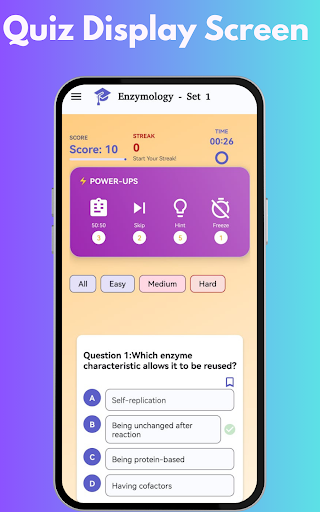
A complete, research-focused enzymology text for Biochemistry, Molecular Biology, Life Sciences, Biotechnology & Biomedical students. Includes full syllabus, MCQs, quizzes, lab skills, and research-based preparation.
🧬 Unit 1: Introduction to Enzymology
• Definition & scope of enzymology
• Enzymes vs. non-biological catalysts
• Roles of enzymes in metabolism & physiology
• Enzyme (EC) classification system & nomenclature
• Enzymes in biotechnology & medicine
🧪 Unit 2: Chemical Principles Relevant to Enzymes
• ΔG, ΔH, ΔS basics
• Activation energy & TST
• Reaction coordinate basics
• Acid–base catalysis
• Covalent vs. non-covalent forces
• Thermodynamic coupling
🔬 Unit 3: Enzyme Mechanisms of Catalysis
• Catalytic strategies
• TS stabilization
• Nucleophilic/Electrophilic steps
• Substrate distortion
• Chymotrypsin mechanism
🧾 Unit 4: Enzyme Kinetics I — Fundamentals
• Michaelis–Menten derivation
• Steady-state assumptions
• Km & Vmax basics
• kcat & efficiency
• Kinetic constant determination
📊 Unit 5: Enzyme Kinetics II — Complex Systems
• Ordered mechanisms
• Random mechanisms
• Ping-pong mechanisms
• Allosteric kinetics
• Hill equation
• pH & temperature effects
🧬 Unit 6: Enzyme Inhibition & Regulation
• Competitive inhibition
• Noncompetitive inhibition
• Uncompetitive inhibition
• Mixed inhibition
• Irreversible inhibition
• Allosteric control
🧪 Unit 7: Enzyme Evolution, Specificity, & Engineering
• Gene duplication
• Enzyme promiscuity
• Directed evolution
• Rational design
• Stability engineering
🧫 Unit 8: Cofactors, Coenzymes, & Prosthetic Groups
• Coenzymes vs. metals
• NAD/NADP
• Flavins (FAD, FMN)
• PLP
• Biotin & CoA
• Metal ions (Zn, Mg, Fe, etc.)
🔬 Unit 9: Techniques in Enzymology
• Enzyme extraction
• Ion-exchange chromatography
• Affinity chromatography
• Size-exclusion chromatography
• Ultracentrifugation
🧾 Unit 10: Biophysical & Structural Tools
• UV–Vis assays
• Fluorescence
• CD spectroscopy
• EPR spectroscopy
• Stopped-flow kinetics
📊 Unit 11: Enzymes in Metabolism
• Glycolysis enzymes
• Oxidative phosphorylation
• Fatty-acid enzymes
• Amino-acid enzymes
• Feedback control
🧬 Unit 12: Clinical & Diagnostic Enzymology
• Enzyme biomarkers
• ALT/AST tests
• LDH in disease
• Metabolic defects
• Clinical enzyme assays
🧪 Unit 13: Industrial & Applied Enzymology
• Food enzymes
• Detergent enzymes
• Textile enzymes
• Biofuel enzymes
• Green biocatalysis
🧫 Unit 14: Computational Enzymology
• Sequence analysis
• Phylogenetics
• Structure prediction
• Docking studies
• Molecular dynamics
🔬 Unit 15: Modern Frontiers
• De novo enzyme design
• Catalytic antibodies
• Metalloenzymes
• Ribozymes
• Single-molecule enzymes
• Synthetic biology circuits
🧾 Unit 16: Laboratory Practicals
• Extraction protocol
• Bradford/Lowry
• Activity assays
• pH effect test
• Km & Vmax experiments
📊 Unit 17: Problems & Exercises
• Michaelis–Menten calculations problems
• Inhibition data analysis problems
• Multi-substrate kinetics problems
• Mechanism deduction feom data
✨This app is inspired by the authors:
Thomas Palmer, David Nelson, John Smith, Akio Yamamoto, Richard Wolfenden, and Paul Engel
📲 Download now from Play Store to access the complete Enzymology (2026–2027 Edition) with syllabus, MCQs, quizzes, analytical techniques & research-focused learning.