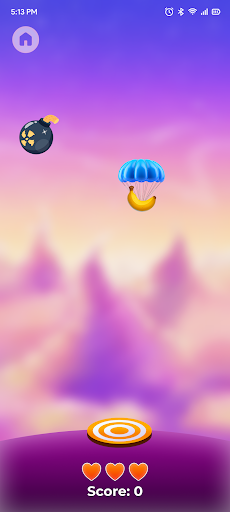
A calm sky isn’t always as calm as it looks. Each round begins with a crate or other cargo drifting into view beneath a broad canopy. It descends steadily, almost lazily, until a quick cross-breeze snaps the fabric and tilts the lines. That sudden nudge is your cue to act. With short swipes on the left or right cords you trim the canopy, bring it back to center, and coax the cargo toward the flashing touchdown zone near the bottom edge. The rhythm is soothing: watch the atmosphere, correct the drift, line up the approach, and touch down on target. When the crate kisses the center of the marked zone before crossing the lower boundary, your score ticks upward and the next descent begins without fuss.
The air, however, doesn’t make it easy for long. Gusts arrive at unpredictable moments and briefly rotate the canopy, sending the trajectory sideways. They don’t last long, but they’re strong enough to force a quick decision. Over time this becomes second nature, and a perfect settlement on the pad gives a satisfying jolt of confidence, punctuated by a short vibration if you’ve left haptics on.
There’s weather above as well as wind. Lightning forks and bombs sometimes drop from the upper sky and will punch through the canopy if they connect. Their presence adds a dash of suspense to an otherwise tranquil glide. A hit removes one of your three hearts, and so does a sloppy landing outside the zone. Run out of hearts and that particular session ends, but not before you’ve felt the loop of learn-adjust-improve click into place. There’s also a sense of momentum: string together five clean landings in a row and one heart returns, never exceeding the original three. It’s a forgiving, encouraging touch that rewards focus without ever feeling punishing.
What keeps the flow engaging is how the sky slowly tightens its grip as your score grows. Gusts become a little more frequent, and those moments of turbulence ask for faster fingers and better timing. The chance of a lightning strike or a bomb appearance climbs too, which means you’ll start planning approaches that leave room to dodge while still converging on the target. None of this feels fussy or technical; it’s just you, a suspended crate, and the satisfying precision of guiding a canopy through shifting air.
Around the action sits a simple, considerate frame. On first launch you can read a full privacy policy and decide whether to allow gentle reminder notifications about new drops; if you opt in, they arrive at most once per day. A straightforward main screen lets you start, peek at a short set of instructions, adjust basics like sound, vibration, and notifications, or exit. During play you can always head home if you need a breather, and the heads-up display stays unobtrusive: hearts for lives, a clear score readout, and the landing zone that pulses just enough to be readable without intruding on the sky.
The feeling of play is tactile and direct. Short swipes on the cords translate immediately into canopy trim, so tiny corrections matter. You’ll find yourself making micro-inputs to hold a steady line through a gust, then a confident cut to slide onto the center stripe. Every good landing is a small, satisfying decision delivered at exactly the right moment. The presentation leans into clarity—clean silhouettes, readable motion, and feedback that tells you what happened without stealing attention from the descent.
This is a space for quick sessions and quiet mastery. You can pick it up for a minute, thread a crate through a couple of gusts, and put it down again; or you can settle in and chase a higher count of precise landings as the air grows playful and the sky tests your timing. Because rounds are brisk and restarts are immediate, the loop never drags. Miss a pad, take a breath, and you’re already easing another canopy into the wind, eyes on the glow of the landing zone and fingers ready to trim the lines.